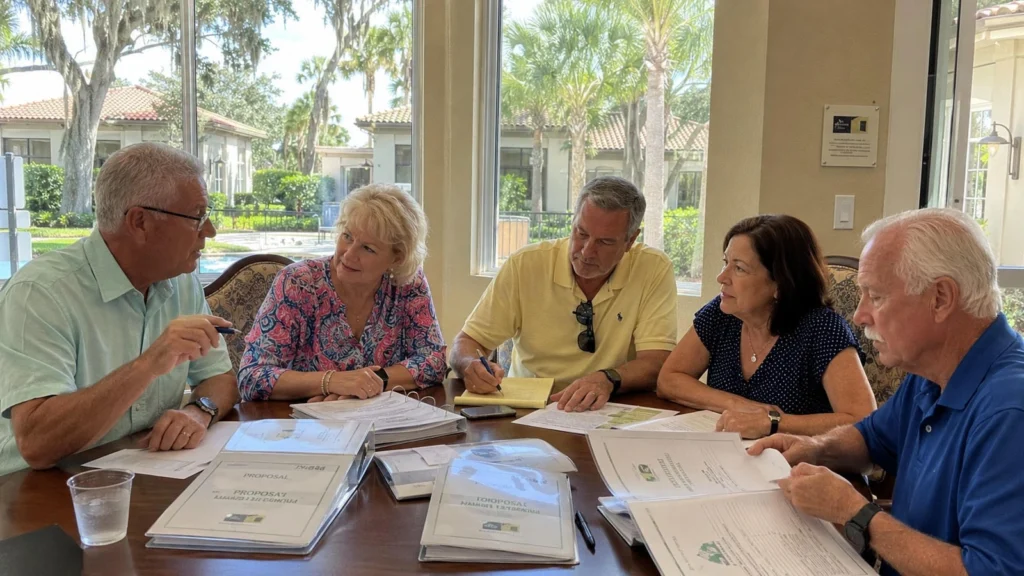
What Is an HOA Management Company?
An HOA management company is a licensed firm hired by a community association board of directors to handle the community’s daily operations under a written management agreement.
This guide is written for HOA and condo association boards in Florida, with particular attention to coastal communities in Northeast Florida (Volusia, Flagler, St. Johns, Duval, Nassau) and Southwest Florida (Naples, Fort Myers, Bonita Springs). The five categories of management work are largely the same statewide, but the operational rhythm of a coastal condo board is different from an inland HOA, and this guide reflects both.
Florida law requires the firm and its managers to be licensed. Any firm working with an association with more than 10 units or a budget over $100,000 must hold a community association management firm license from the Department of Business and Professional Regulation (DBPR). Each manager who works directly with your community must also have an individual Community Association Manager license (LCAM).
The Board and the Management Company: Two Different Roles
The management company is an Agent acting on behalf of the board for operational matters. Decision-making authority belongs to the elected board of directors. The management company is not the HOA or the board.
Florida law puts fiduciary responsibility for the association with the board. The duty is defined in Florida Statute 720.303 for HOAs and 718.111 for condo associations, with additional structure in the Florida Not-For-Profit Corporation Act (Chapter 617). Within the first 90 days of taking office, a Florida director signs a written certification acknowledging that duty, and most directors complete state-approved education during their certification window.
The management company has only the authority that the board grants under the management agreement. Even the emergency authority is defined in advance, so the management company knows exactly what it can act on without having to return to the board. Key decisions, such as the budget, rules, assessments, vendor choices, and spending approvals, belong to the board.
In practice, that means the board makes the calls, and the management company carries them out. If the board funds a roof reserve at a specific level, the management company sets up the line item, runs it by the board, transfers it, and reports against the budget. If the board adopts a violation policy, the management company sends responses and presents the records to the board for action.
The relationship runs both ways. A good management company surfaces issues with options and a recommendation in hand. The board still makes the call.
The Four Categories of HOA Management Work
The work breaks down into four core categories.
Financial operations
Financial operations are often the most visible and important part of working with a management company. Boards usually judge their management company by how well the finances are handled. A strong financial operation for a Florida community association includes:
- Assessment billing, collection, and posting (regular dues, special assessments, and any owner-level charges).
- Accounts payable, which covers vendor invoicing, board approval workflow, and payment processing.
- Bank account management for operating and reserve accounts.
- Monthly financial reporting (balance sheet, income and expense statement, budget vs. actuals, AR and AP aging).
- Budget development support and budget tracking through the year.
- Reserve account tracking against the reserve study, executing the funding plan the reserve specialist authored.
- Coordination with the auditor or compilation accountant for year-end work, and with the insurance broker on premium payment schedules and proof of coverage.
At MAY Management, our financial team works in-house. Each association gets a dedicated accountant, financial packets arrive on schedule, and the board can see every invoice in real time before payment.
Administrative and communication work
This is the part that owners and board members interact with most often:
- Board meeting preparation: agendas, notices, packets, minutes.
- Annual meeting and election support: notices, candidate materials, voting, certification of results.
- Owner communication: via portals, email, and mail correspondence, and response logs.
- Architectural review intake, board routing, and decision communication.
- Violation intake, tracking, and notice issuance per the board’s enforcement policy.
- Records management: governing documents, recorded amendments, prior meeting minutes, and official records compliance under Florida Statutes 720.303(5) and 718.111(12).
- Website compliance under Florida Statute 718.111(12)(g) for condo associations with 25 or more units, including password-protected owner access to governing documents, meeting notices, budgets, minutes, and financial reports.
Maintenance oversight and vendor coordination
It takes ongoing attention to keep the common areas in good shape:
- Regular property inspections and condition reporting.
- Work-order intake from owners and from inspections, with prioritization and dispatch.
- Vendor management: bid coordination, contract execution, scheduling, and performance review.
- Project coordination for capital projects approved by the board: the engineer specifies the work, the management company runs the bid with licensed contractors and manages the schedule, and the contractors perform the work.
- Coordination of insurance claims after property damage (the broker handles the claim itself; the management company coordinates the property side).
- Hurricane preparation, in-storm board communication, and post-storm operational recovery, especially for coastal communities in Northeast and Southwest Florida.
Governance and board support
This is the work that keeps everything running smoothly:
- Board orientation and ongoing education, including support for the four-hour director certification course required for new Florida directors.
- Calendar management for statutory deadlines (annual budget adoption, reserve study updates, SIRS deadlines for condo associations, milestone inspection coordination under Florida Statute 718.501).
- Document organization: clean records that the board can reference and that meet Florida official-records requirements.
- Coordination with the association’s attorney, auditor, reserve specialist, insurance broker, and engineer as projects require.
This support helps make board service manageable. Boards are most effective when they can focus on governance rather than on records and deadlines. The management company’s job is to handle those details for the board.
What Does an HOA Management Company NOT Do?
A management company doesn’t do the specialist work. These roles belong to separately credentialed professionals that the association engages directly:
- The reserve specialist prepares the reserve study, and the Structural Integrity Reserve Study required for Florida condo associations of three or more habitable stories. The management company coordinates the engagement, supplies the records the specialist needs, and executes the funding plan the specialist recommends. The reserve numbers are the specialist’s professional opinion.
- The CPA performs the audit, review, or compilation required for the association’s financial year. The management company prepares the books and supplies records. The opinion belongs to the CPA.
- The engineer assesses structural condition, recommends repairs, designs major capital work, and performs the milestone inspection required under Florida Statute 718.501. The management company coordinates the engagement, runs the bid with licensed contractors, manages the project schedule, and reports to the board. The contractors perform the repair work.
- The insurance broker assesses coverage, recommends policies, places coverage in the market, and adjusts coverage as conditions change. The management company executes premium payments, maintains certificates of insurance on file, and coordinates with the broker on renewal cycles.
- The association’s attorney interprets the governing documents and Florida statutes, drafts amendments and resolutions, handles collections and legal enforcement, and provides legal authority on any question the board faces. The management company surfaces issues, organizes the documents, and follows the attorney’s direction.
- The forensic engineer investigates construction defects when the association needs one. The management company never makes that call.
For the board, working with a management company means having a coordinated team behind you. You set the direction, and the management company keeps the engineer, CPA, attorney, broker, and reserve specialist focused on your priorities and timeline.
Does Florida Require HOA and Condo Associations to Use a Licensed Management Company?
The short answer is no. Florida law does not require an association to hire a management company. Self-management is an option, and some communities run that way successfully.
The bigger question is whether self-management is a good fit for your community. It requires board volunteers with sufficient time, experience, and consistency to handle finances, meet legal deadlines, manage vendors, communicate with owners, and stay up to date with Florida law. For small, stable communities, this can work. But for most larger communities, especially condos with extra requirements, the workload is why boards choose professional management.
If the association does hire management, Florida law requires the firm and the individual managers to be licensed. Any firm providing management services to a Florida association with more than 10 units or a budget over $100,000 must hold a community association management firm license issued by the DBPR. Every manager serving the community must hold a Community Association Manager (CAM) license. Verification is public at myfloridalicense.com.
For most boards, the main question isn’t whether to hire a management company, but whether the company you choose is prepared to handle your community’s needs.
How the Board and the Management Company Work Together
The day-to-day relationship with your management company develops a routine. After a few months, you’ll know what to expect. This predictability helps make board service manageable.
The CAM is the board’s primary contact. The dedicated Community Association Manager handles the operational decisions the board has delegated, runs the board meeting cycle, and is the main point of contact in between. When a vendor goes sideways, an owner questions it, or a statutory deadline is approaching, the CAM is the one moving it.
The community manager isn’t on an island. At MAY, every community manager is backed by a Community Assistant, a General Manager, a Regional Manager, and the EVP of Management Services. If the manager is out for a week, the board doesn’t lose access to its information. If a question is bigger than the day-to-day, the people above the CAM are already in the picture. The board’s relationship is with the team, so continuity doesn’t depend on any one person staying.
Financial communication is the second piece. The Client Accountant prepares and reviews the monthly financial packet, responds to the treasurer’s questions, and supports the budget throughout the year. At MAY, the Client Accountant and the community manager work in the same office, which sounds like a small detail until you’ve been on a board where operations and accounting give conflicting answers. Same office means the answer is reconciled before it reaches the board.
Board meeting support is the third piece. The management company drafts the agenda with the board, prepares the packet, presents operational and financial updates and tracks tasks through the next meeting. A competent firm closes most items within the cycle and reports the rest with clear owners and dates. The board sees movement, not a growing list of open topics.
Coastal Florida Communities Run on a Different Tempo
A coastal Florida community runs on a different operational tempo. In Northeast Florida (Volusia, Flagler, St. Johns, Duval, Nassau) and Southwest Florida (Naples, Fort Myers, Bonita Springs), the work that defines coastal community management includes hurricane preparation through May and June, board communication during named-storm activity, post-storm vendor coordination and insurance claim support, salt-air exterior maintenance cycles that run faster than inland properties, flood insurance management, and (for condo associations of three or more habitable stories) milestone inspection coordination under Florida Statute 718.501.
A coastal board uses its management company to keep these workstreams running through the calendar year, not just during a named-storm event. The pre-season checklist, vendor list, post-storm recovery playbook, and broker relationship aren’t set up when a storm forms. They’re maintained year-round. The board sets priorities and approves spending. The management company runs the cycle.
MAY operates five offices across ten Florida markets and has been doing this work since 1988. The hurricane seasons are not theoretical.
Technology and the Modern Management Operation
Over the last decade, technology has reshaped the operational layer. The board’s role hasn’t changed. The tools that support it have.
Three categories of platforms power modern Florida community management operations.
The first is a community association management platform that handles assessments, owner records, work orders, and communication in one system. MAY uses Vantaca.
The second is an invoice and AP platform that gives the board real-time visibility into every invoice before it’s paid. MAY uses Strongroom.
The third is AI-supported tools for owner-question response and routine task completion. MAY’s HOAi has answered more than 8,000 homeowner questions. 93% of responses are approved by the CAM without changes, and only 3% require human intervention.
None of this changes what boards actually need: a community manager they trust and a Client Accountant they can call by name. The platforms make that relationship run cleaner, not different.
How MAY Approaches the Management Relationship
MAY Management Services has supported Florida boards since 1988. Today, MAY serves 220+ communities and 29,000+ homes across five Florida offices and ten markets.
The structure behind every account: a 15-person in-house Florida accounting team, 36 licensed CAMs, and a four-tier support layer (Community Assistant, General Manager, Regional Manager, EVP of Management Services). The scorecard the board sees: 93% CAM retention, 98% client retention, 92% on-time financial packet delivery.
The coordinating hub model means MAY runs the operational layer, names specialists for work outside our scope, and maintains the board’s records, deadlines, and financials, so the board can focus on governance.
Let’s talk about whether MAY is the right firm for your community.
Faqs
HOA management fees in Florida are typically structured as a per-door, per-month rate. The total fee is driven by the size of the community, the scope of services in the management agreement, the level of on-site or off-site staffing required, and the complexity of the community type (HOA, condo, master-planned, mixed-use). Boards should request a written fee schedule that itemizes the base management fee, any per-meeting or per-project add-ons, and pass-through costs (postage, printing, legal coordination) before signing the agreement.
Portfolio management means one Community Association Manager handles a portfolio of associations, splitting time across communities and supported by accounting, administrative, and leadership staff at the firm’s office. The community manager attends scheduled board meetings, conducts regular site visits (often weekly or biweekly), and is reachable by phone and email between visits. It’s the standard model for small and mid-size HOAs and condo associations.
On-site management means the community manager, and often additional staff such as a maintenance director, administrative assistant, or assistant manager, is physically based at the community full-time, working out of an office on the property. It’s typically reserved for larger communities, high-rises, master-planned communities, age-restricted communities, or communities with amenities that require day-to-day operational support. The on-site model comes with a higher cost in exchange for immediate response time and continuous presence in the community.
Both models draw on the same firm-level back office (accounting, compliance, leadership support). The right model depends on the community’s size, complexity, and the level of on-property staffing the operation needs.
Most Florida HOA and condo management agreements run one to three years, with auto-renewal language unless the board acts within a defined window (often 30 to 60 days before the renewal date). The contract length and the auto-renewal terms are the two clauses the board should pay closest attention to before signing. A board that misses the auto-renewal notice window may be locked in another full contract term.
Usually, yes, depending on the topic and the management agreement. The community association manager is typically present to provide operational context, take notes, and track action items from the session. For sessions involving sensitive legal matters, the board often excludes management and meets only with the association’s attorney. The board’s attorney is the right person to advise on what’s appropriate for any specific session.
The association pays the management company as a budgeted operating expense, funded through homeowner assessments. Individual homeowners do not pay the management company directly. The management fee is folded into the association’s annual budget, which the board adopts and funds through regular assessments collected from owners.