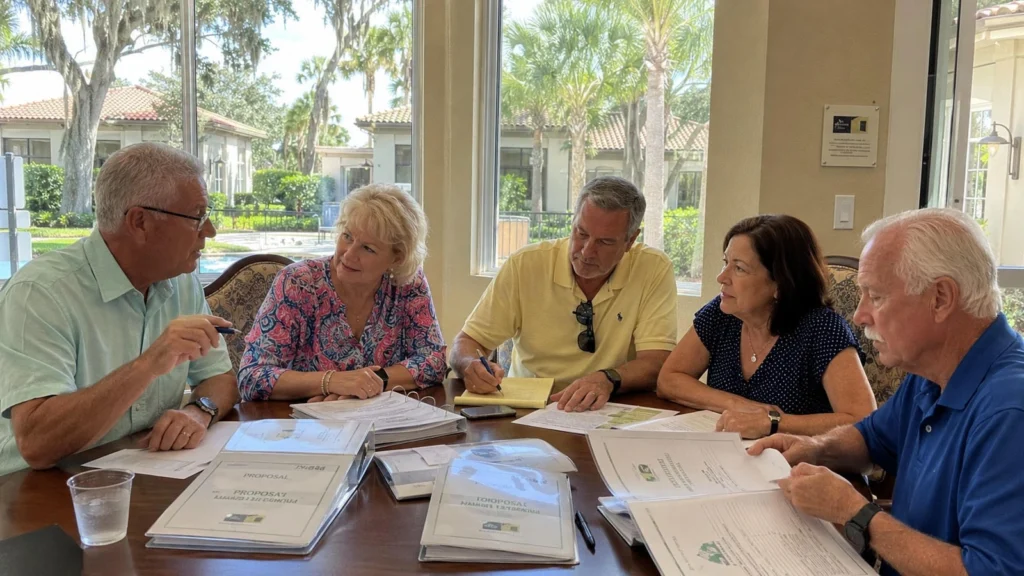
An HOA board is responsible for the decisions that keep a community financially sound and physically maintained: approving the budget, funding reserves, hiring and overseeing vendors and professionals, maintaining common property, and consistently applying the community’s governing documents. Board members are volunteers who direct the work. They are not expected to perform it, and the most effective ones spend far more time deciding than doing.
What does an HOA board do?
Most people join a board because something specific bothered them. The pond looks bad. Assessments went up, and nobody explained why. A neighbor got approval for something that seemed to break the rules. Then they attend their first meeting and discover the job is much broader than what brought them in.
Strip away the detail and a board does four things. It sets the community’s financial plan and approves the budget that funds it. It maintains and repairs the property the association owns in common. It hires and oversees the people who do the work, from the landscaper to the management company to the attorney. And it applies the community’s governing documents evenly, so that the same situation gets the same answer regardless of who is involved.
Everything else is a version of one of those four. A reserve study is financial planning. A roof project is maintenance and vendor oversight. An insurance renewal is all three at once.
What surprises new members most is how little of this is hands-on. A board member is not the person who calls the plumber. A board member is the person who decides which plumbing contract the association signs, reviews the invoice against it, and asks why the third emergency call this quarter cost more than the first two combined.
How the four officer roles divide the work
Most Florida associations elect a president, vice president, treasurer, and secretary, with the specifics set by the community’s own bylaws. Read yours, because they control this. What follows is how the roles tend to work in practice across the communities we manage.
President
The president runs the meetings and is usually the board’s point of contact with the management company. That second part matters more than people expect. In practice, the president decides what rises to the full board and what gets handled between meetings, making them the community’s pace-setter.
The common failure is a president who becomes the association’s general contractor, fielding owner calls directly, personally directing vendors, and making decisions the board never voted on. It burns the person out, and it puts decisions outside the record. A president who routes work to the manager and keeps decisions at the board table will serve longer and leave the community in better shape.
Vice President
On paper, the VP covers when the president cannot. In well-run communities, the role is more useful than that, because the VP is the natural owner of whatever the board has going on that needs sustained attention: a capital project, an insurance renewal, a committee that needs a board liaison. If your VP has nothing to do, the board is probably under-delegating.
Treasurer
The treasurer is not the association’s bookkeeper. Someone else records the transactions, produces the financial statements, and reconciles the accounts, usually the management company’s accounting team. The treasurer reads that work critically and explains it to the rest of the board in language everyone can follow.
A treasurer who is doing the job well can answer four questions at any point in the year: are we on budget, is anything trending in a direction we should discuss, are reserves being funded on the schedule we adopted, and how are collections tracking. A treasurer who is being asked to keep the books has a service problem, not a workload problem.
Secretary
The secretary owns the records. Minutes, notices, and the association’s official documents. This is quietly one of the most consequential roles on the board, because the records are what a future board, a buyer, a lender, or an insurer will rely on.
Good minutes are short. They capture what was decided, who moved and seconded, and how the vote came out. They do not transcribe the discussion. A board that argues for forty minutes and records one clear motion has a better record than a board that publishes four pages of back-and-forth.
What the board decides, and what it delegates
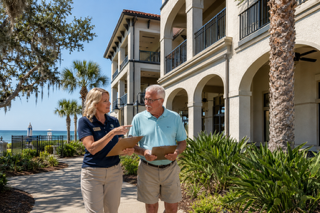
The clearest line we know is this: the board decides, and other people execute.
The board sets the budget. The management company operates within it. The board selects the vendor. The manager holds that vendor to the contract. The board adopts a collection policy. Management applies it the same way in every case, and the association attorney handles anything that moves beyond routine.
Boards get into trouble in both directions. A board that delegates its actual decisions has given away the job the members elected it to do. A board that refuses to delegate execution ends up with five volunteers doing part-time operations work, meetings that run past ten o’clock, and a turnover problem that shows up two elections later.
A practical test for any item on the agenda: does this require the judgment of the people the community elected, or does it require someone’s time? If it is time, it belongs with management or a vendor.
Where a board member’s job ends
This is the part that protects volunteers, and it is worth being blunt about.
Reserve studies are performed by reserve specialists and, where structural components are involved, by licensed engineers or architects. CPAs perform audits, reviews, and compilations. Engineers assess structural conditions. Insurance coverage is placed and negotiated by a licensed broker. Legal questions, including how your governing documents apply to a specific situation, belong to the association’s attorney. Construction defect questions belong to a forensic engineer.
None of those are jobs a board member should take on personally, and none of them are jobs a management company should claim either. Our role, and it is a real one, is to be the hub that keeps those specialists coordinated: scheduling the work, gathering what each one needs, tracking the calendar, and making sure the results actually reach the board in time to inform a decision rather than after it.
When a board member with relevant professional expertise sits on the board, the instinct to handle it is understandable, and it usually creates more problems than it solves. Use the expertise to ask better questions of the retained professional. Do not substitute for them.
What a well-run board year looks like on the Florida coast
Board work has a rhythm, and communities that follow it spend less time reacting.
The first quarter is when the prior year closes, and the financial statements are prepared. The board should also review the reserve schedule early, while there is still time to adjust rather than react.
Spring is insurance and hurricane preparation. On the coast, this season decides how the rest of the year goes. Renewal terms, deductible structure, and the association’s prep plan should all be settled before June, not during it. Coastal communities in Volusia, Flagler, St. Johns, Duval, and Nassau counties, and on the Gulf side in Collier and Lee, carry maintenance and inspection considerations that inland communities do not, and the calendar reflects that.
Summer and early fall are the operating seasons. Projects run, storm readiness is live, and the board’s job is mostly oversight.
Fall is budget season, and it is the most important stretch of the year. This is when the board decides next year’s costs, which reserves to fund, and whether assessments change. Boards that start in August have real choices. Boards that start in November have arithmetic.
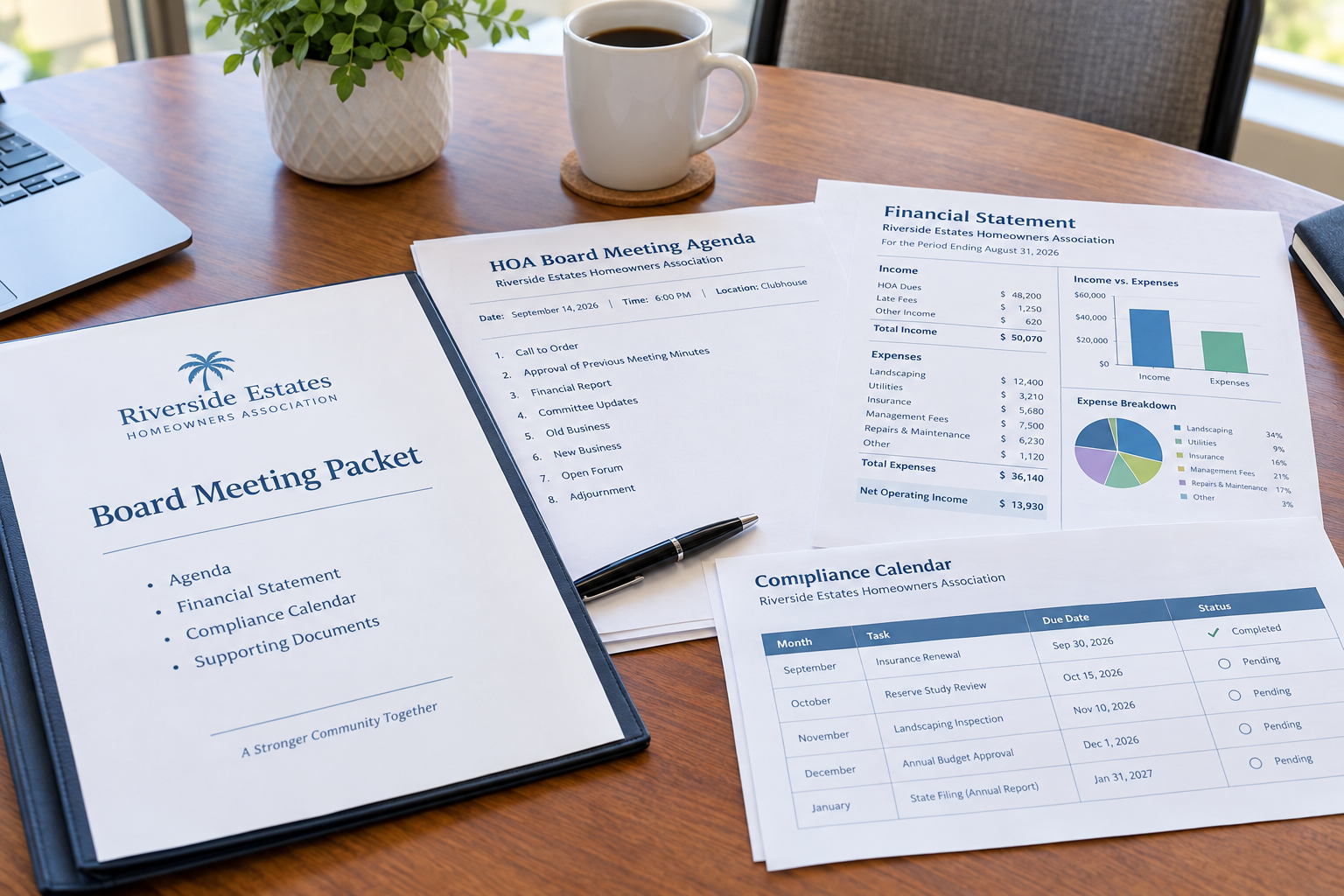
Underneath it all is the association’s compliance calendar: inspection windows, filing dates, meeting and notice requirements, and director education deadlines. That calendar is something your management company should keep and show you, not something the board should be reconstructing from memory each year.
Director education is now part of the job
Florida directors elected or appointed on or after July 1, 2024, must complete a certification or education requirement within 90 days, followed by an annual continuing education component. Per DBPR, condominium directors take a four-hour certification valid for seven years plus one hour annually, and HOA directors take new board member education valid for four years, with annual hours that scale with the size of the association.
The operational point for a board is simply this: it is a recurring calendar item with a deadline attached to each new member, not a one-time formality. Ask your management company how they track it and what happens when a new director is seated mid-year. Your association attorney or an approved provider is the right source for what your specific association needs and how it applies to you.
The habits that separate effective boards from exhausting ones
After enough years, the difference between a board that functions and one that grinds comes down to a handful of habits, not the people involved.
- They read the packet before the meeting. A board that arrives prepared meets for ninety minutes. A board that reads the financials in the room meets for three hours and decides less.
- They vote and move on. Discussion has a purpose, and the purpose is a decision. Boards that revisit settled questions at every meeting train their members to stop attending.
- They put decisions in the minutes, not in email threads. A decision that lives in a group text is a decision nobody can find in two years.
- They treat the manager as a team member with a defined role, and they raise service issues as such rather than absorbing the work themselves.
- They tell owners what is happening before owners ask. Most community conflicts are an information gap that got old.
- And they think past their own term. The board that funds reserves properly is rarely the board that gets to enjoy the new roof.
What a new board member should do in the first thirty days
Read the governing documents. All of them, once, even the parts that seem procedural. You will not retain everything, but you will know what exists and where to look.
Read the last twelve months of financial statements and the last six sets of minutes. That is the fastest way to understand what this community is dealing with.
Find the reserve study and the current funding plan and ask when the study was last updated.
Ask for the compliance calendar and the vendor contract list, including renewal dates.
Meet the community manager and ask what the board could do differently to make the community run better. Managers usually have a clear answer and are rarely asked.
Complete your director education and get it on the calendar rather than leaving it to the deadline.
How MAY supports the boards we work with
MAY has managed Florida communities since 1988. We currently serve more than 200 communities and roughly 27,500 homes across 10 Florida markets, supported by a Florida-based, 15-person in-house accounting team.
Board members feel most supported when the routine work is already handled. Financial packets arrive on schedule, with a 92 percent on-time delivery rate, so the treasurer is reading current numbers rather than chasing them. We maintain the compliance calendar and present it to the board ahead of deadlines. We coordinate specialists rather than volunteers using vacation days. And our managers stay: average manager tenure is 7 years, and our CAM retention is 93 percent, which means the person who knows your community in January is the person who knows it in December.
If your board is spending its meetings on operational work instead of making decisions, that is usually a service gap rather than a board problem, and it is fixable.