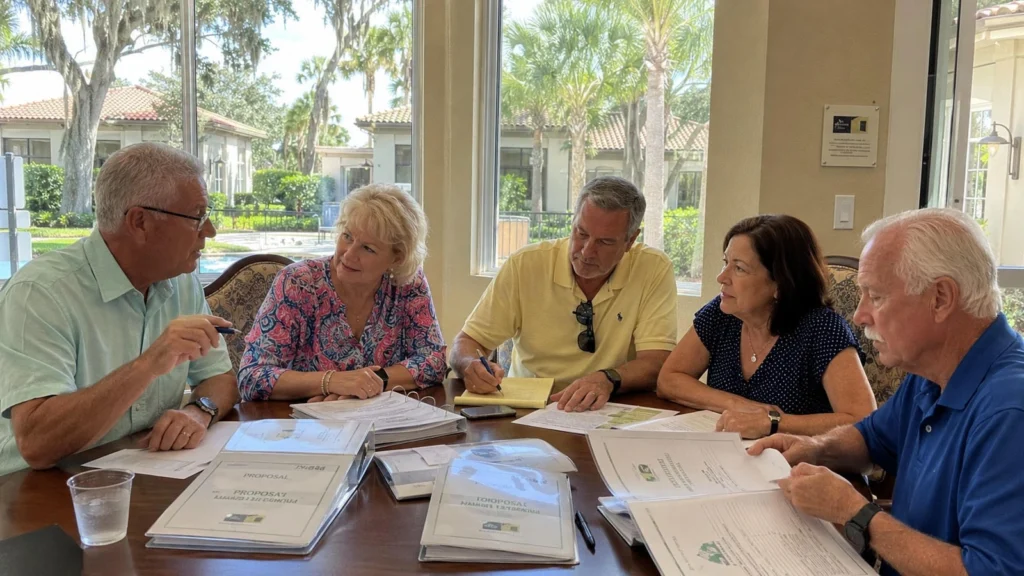
The clearest signs an HOA or condo management company is underperforming are financial reports that arrive late or contain errors, frequent manager turnover that resets your progress, requests that go untracked or unanswered, missed compliance and reserve deadlines, and hearing about problems from residents before you hear about them from your manager. One slip can happen to anyone. A pattern across two or more of these is the signal for a Florida board to evaluate its options.
How do you know if your HOA management company is underperforming?
Most boards do not wake up one day and decide to switch management companies. The realization builds slowly. A late financial packet here, a manager who leaves there, a work order nobody can find. Individually, each one is easy to explain away. Together, they add up to a board that spends more time managing its manager than leading its community.
The signs below are drawn from what Florida boards most often tell us. Read them as a diagnostic, not a verdict. The goal is to help you see a pattern clearly enough to have an honest conversation, either with your current company or with an alternative.
1. Your financial reports arrive late, or they arrive wrong
Financials are the board’s single most important tool. You use them to approve spending, plan repairs, set the budget, and respond to owners. When the monthly packet shows up weeks late, or the numbers do not reconcile, the board is approving spending it cannot verify.
Watch for reports that do not match your bank statements, reserve balances that move without explanation, or a treasurer who has to rebuild the numbers by hand before every meeting. Timely, board-ready financials are a baseline expectation, not a premium service. At MAY, our 15-person in-house accounting team has a Client Accountant assigned to every association, so the people who know your books work closely with the people who know your community.
2. You have had three managers in two years
Manager turnover is the pain Florida boards name most. Every time a community manager leaves, the board starts over: re-explaining the history, the vendors, the personalities, the open projects. Progress resets. Institutional knowledge walks out the door.
Some turnover is normal in any industry. A revolving door is not. If you cannot remember your current manager’s name because they have not been around long enough, that is a structural problem, not a personality one. It usually points to managers who are overextended and unsupported. MAY’s 93% CAM retention rate is the number we watch most closely, because when your manager stays, the progress your board makes stays with them.
3. Requests disappear into a black hole
You email a request. Nothing happens. You follow up. Still nothing. You are not sure whether the ball was dropped or ever picked up. When a board cannot see the status of its own requests, accountability breaks down and small issues become large ones.
A capable management company runs on a system, not on memory. Every request should be logged, assigned, and trackable, so the board can see what is open, what is done, and who owns it. MAY uses Vantaca to track work end-to-end, which means nothing lives or dies in a single person’s inbox.
4. Nobody is watching your compliance and reserve calendar
Florida gives boards a real calendar of obligations: annual budgets and reserve disclosures, and for condominium and cooperative buildings, milestone inspections and structural integrity reserve studies are on statutory timelines. When no one at your management company is tracking those dates, the board is exposed to deadlines it did not know it had.
If you have asked your manager a compliance question and gotten a blank stare, or if reserve planning never comes up until budget season, that is a sign. A management company will not act as your attorney or your engineer and should never claim to. Its job is to keep the calendar, prompt the board in time, and coordinate the specialists who do that work. If you want a deeper background, our guide to reserve fund studies in Florida walks through what boards need to track.
5. You hear about problems from residents before your manager
When an owner emails you about a broken gate, a billing error, or a vendor who never showed, and it is the first you are hearing of it, your management company is behind the community rather than ahead of it. Boards should learn about operational issues from their manager, with a plan already attached, not from the neighbors at the mailbox.
6. Board meetings run long because nobody prepared them
A well-supported Association sends the board a clean agenda, a manager’s report, current financials, and the handful of decisions that need a vote, all before the meeting. When meetings run two and three hours because the board is reconstructing basic information in real time, the preparation is not happening upstream. Your volunteers’ time is the scarcest resource in the community and should be treated that way.
7. Vendor oversight is thin
Coastal Florida communities live and die on vendor performance: landscapers, roofers, pressure-washing crews, elevator and pool contractors, and after a storm, restoration vendors. If your management company is not soliciting competitive bids, checking insurance and licensing, and holding vendors to the contract, the board is absorbing risk it should not have to. Ask when your major contracts were last bid. If the answer is a shrug, that is a sign.
What should a Florida board do about it?
Start by naming the pattern honestly. Pick the two or three signs above that describe your community and gather the evidence: the dates the financials arrived, the number of managers in the last 24 months, and the requests still open after 30 days. Bring it to your current company first. A good partner will own the gaps and show you a plan. If the same conversation keeps happening with no change, you have your answer.
Switching is less disruptive than most boards fear when it is handled well. The transition follows a defined process, and the right timing usually avoids hurricane season and the budget cycle. Our guide to switching HOA management companies in Florida lays out the steps, timeline, and what to expect.
Serving Florida communities since 1988, MAY Management supports 200+ communities and 27,500+ homes across 10 Florida markets, with a 98% client retention rate. Let’s talk about what better management looks like for your board.
Faqs
There is no fixed rule, but a reasonable approach is to document the specific problems, address them formally in writing, and give the management company a defined period, often 60 to 90 days, to show measurable improvement. If the same issues continue after a clear conversation and a fair opportunity to make changes, the board can begin evaluating other management options.
Not always. Some level of employee turnover can happen in any company, and one manager leaving does not necessarily indicate a problem. The bigger concern is a repeated pattern of turnover within a short period. Frequent changes can make it difficult for the board to maintain continuity and may indicate that managers are handling too many communities or lack adequate support.
Florida boards should pay attention to financial reports that are consistently late, figures that do not reconcile with bank statements, unexplained changes in reserve balances, or situations where the treasurer regularly has to correct or rebuild financial information before meetings. Boards should receive timely, accurate, and understandable financial reports. Ongoing problems with basic financial reporting deserve closer attention.
It depends on the terms of your management agreement. Many contracts include notice requirements, termination provisions, or specific conditions for ending the agreement early. Before taking action, review the contract carefully and confirm the applicable requirements with your association attorney. This information is provided as general operational guidance and is not legal advice.
A management change does not have to disrupt community operations when the transition is properly planned. A structured handoff should cover financial records, vendor contracts, owner information, maintenance requests, open projects, and other important community records. Boards should also consider the timing of the transition and select a management company with an organized onboarding process to help maintain continuity.
Ask how managers are supported, how long managers typically stay with the company, how financial reports are prepared and delivered, and how board and homeowner requests are tracked. It is also helpful to ask how the company manages compliance deadlines, reserve planning, vendors, maintenance, and community projects. Speaking with current board clients can provide additional insight into how the management company works in practice.
This article is operational guidance for board decision-making, not
legal advice. Confirm contract terms and any statutory obligations with your
association’s attorney.